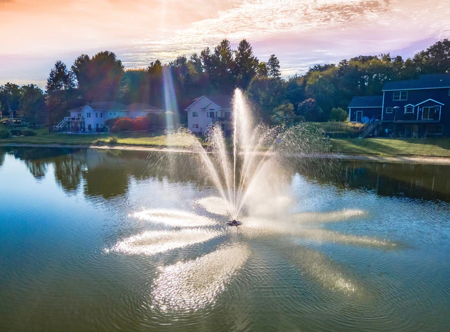
If you’ve ever noticed a pond change from blue to green in a matter of a summer season, you’ll know just how quickly this change can happen. In a week or two, everything will be fine. Then, a few weeks later, there is a thick layer of algae along the edges, a stench that can’t be ignored, and a general sense that something has gone wrong. The question most pond owners will be asking themselves at this point is whether a pond fountain would have made a difference, or if it would have made any difference at all.
The honest answer is: it depends. But in the right conditions, yes, a pond fountain does make a real difference for algae control. Here is why.
What Algae Actually Needs to Spread
Algae isn’t complicated. It needs sunlight, warm water, and nutrients to develop. Strip away any one of those, and growth slows. The problem is that most ponds naturally supply all three, especially in summer.
Phosphorus and nitrogen are the nutrients that drive algae growth most aggressively. They enter ponds through runoff from lawns, agricultural land, and surrounding soil. Once they’re in the water, they don’t just disappear. They accumulate, particularly in still, warm water near the surface.
That accumulation is where things get bad. The EPA identifies nutrient loading as the leading cause of eutrophication, a process where excess nutrients cause algae blooms and deplete oxygen in the water. Ponds without adequate water movement are far more susceptible to this cycle.
Where Pond Fountains Come In
A pond fountain moves water. That sounds simple, but the effects on algae are more specific than most people expect.
Algae, particularly cyanobacteria (blue-green algae), thrive in warm, still, nutrient-rich surface water. It doesn’t do nearly as well in moving water with higher oxygen content. A fountain doesn’t eliminate the nutrients, but it changes the conditions that allow algae to concentrate and bloom.
Think about where algae tends to form first in a pond. It’s almost always in the corners, the shallow edges, the spots with the least movement. That’s not a coincidence.
The Research Behind It
The University of Florida IFAS Extension has published research on pond aeration and its relationship to algae management. Their research indicates that aeration of the pond surfaces through a fountain-style aeration system decreases the incidence and severity of algae bloom problems in shallower ponds, specifically those ponds that are 6 feet deep or less. The water moves, the surfaces change, and the algae have a harder time blooming.
A study published through the North American Lake Management Society found that destratification, the process of breaking up layered water temperatures, reduced internal phosphorus loading in treated ponds compared to untreated ones. This means that there is less phosphorus available to support algae growth.
These changes don’t happen overnight. The study shows that improvements occur over the course of a full season of aerating the pond. It’s not a magic solution that happens quickly.
See also: Cybersecurity Strategies for Small Businesses
What a Pond Fountain Can’t Do
It’s important to know that a pond fountain can’t do everything. A pond fountain is not a water treatment system. It does not remove nutrients that have been building up in the pond. If your pond has years of sediment and organic material that is releasing phosphorus into the pond, it’s not going to help.
Ponds with very high nutrient loads from surrounding land use may need additional management approaches. Aquatic plant buffers along shorelines, sediment treatment, and watershed management all play a role in reducing the nutrient input that drives algae in the first place.
A fountain works best as part of a broader management approach, not as a standalone solution to a severe algae problem. That said, for ponds dealing with moderate algae pressure, consistent fountain operation through the warm months makes a measurable difference.
Cyanobacteria and the Risks
This is where algae control stops being just an aesthetic issue. Cyanobacteria blooms can produce toxins called cyanotoxins that pose real health risks to people, pets, and livestock. The EPA and CDC have both documented cases of illness and animal deaths linked to contact with contaminated water.
Not every algae bloom is toxic. But you can’t tell by looking at it. If your pond is near a recreational area, a grazing field, or anywhere children or animals have access to the water, algae blooms carry a liability you probably don’t want to test.
Sizing Matters More Than You Think
A fountain that’s too small for the pond’s surface area won’t create enough circulation to make a difference. Most aquatic management guidelines recommend sizing aeration systems based on pond acreage and average depth.
For ponds up to half an acre, a single properly sized fountain unit generally provides adequate surface coverage. Larger ponds need multiple units or supplemental aeration. Running an undersized fountain and expecting it to control algae across a large water body is a common mistake, and it’s worth getting the sizing right before assuming the approach doesn’t work.